The time is now
Lemurs are the most endangered mammals on Earth

about
Duke Lemur Center
Founded in 1966 on the campus of Duke University in Durham, NC, the Duke Lemur Center is a world leader in the study, care, and protection of lemurs—Earth’s most threatened group of mammals.
With more than 200 animals across 13 species, the DLC houses the world’s most diverse population of lemurs outside their native Madagascar.
Want to visit? We’d love to host you! Just note that tour reservations are required in advance.
Our Mission
To advance science, scholarship, and biological conservation through non-invasive research, community-based conservation, and public outreach and education.
Facebook Feed
Celebrate World Lemur Day early by ordering a blue-eyed black lemur plush or adopt package! 💙
shop.duke.edu/specialties/duke-shoppes/lemur
Blue-eyed black lemurs are one of the most endangered primate species in the world, with possibly fewer than 1,000 individuals remaining in the wild. The Duke Lemur Center houses about half of the blue-eyed black lemurs in North America and is one of the only facilities in the world to successfully breed these critically endangered animals 🌍
This #WorldLemurDay, you can support blue-eyed black lemur care and conservation by purchasing a limited time adoption package, staying connected to blue-eyed black lemur pair Leigh and McAvoy through quarterly email updates through the end of 2027. Your $150 symbolic adoption includes BOTH a male and female plush of this sexually dichromatic species, as well as a full color booklet, stickers, postcards, and a link to your online portal, where you can read more about Leigh and McAvoy and sign up for your email updates 🥰
Plushes are also available for individual sale, if you want a cuddly companion custom designed based on photos of our resident lemurs! Both the female (orange) and male (black) plushes feature Duke bandanas (removable for any UNC fans in the audience 👀) and fur that one customer described as "as soft as a Jellycat" 🧡💙
All purchases give back to lemur care and conservation, so you can feel good about your shopping! Shipping is available both within the United States and internationally 📦 ... See MoreSee Less
4 CommentsComment on Facebook
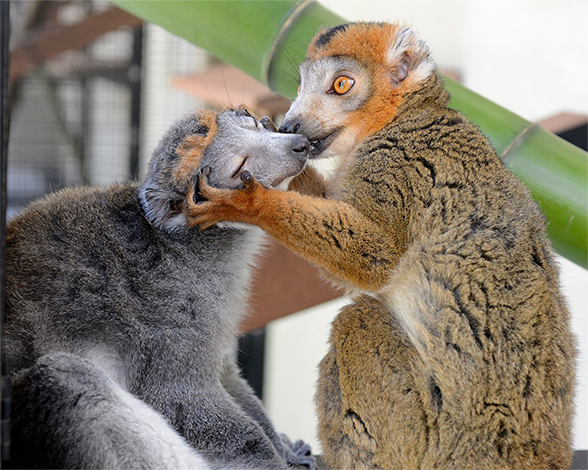
Collared lemur pair Brie and Bentley share some beautyberry (and a little kiss at the end) 😘
Unlike about 95% of lemur species, which are female dominant, there does not appear to be a clear dominance hierarchy within collared lemur groups... so Brie and Bentley are equals in their co-dominant relationship! Like other species in the Eulemur genus (blue-eyed black lemurs, mongoose lemurs, crowned lemurs, etc.), collared lemurs are sexually dichromatic, meaning that males and females can be distinguished by their coloration. If you look closely, you'll notice that Bentley's head is jet black, while Brie's is dark gray! 🧡
📸: David Haring ... See MoreSee Less
7 CommentsComment on Facebook
This is an Ardrey appreciation post 💖
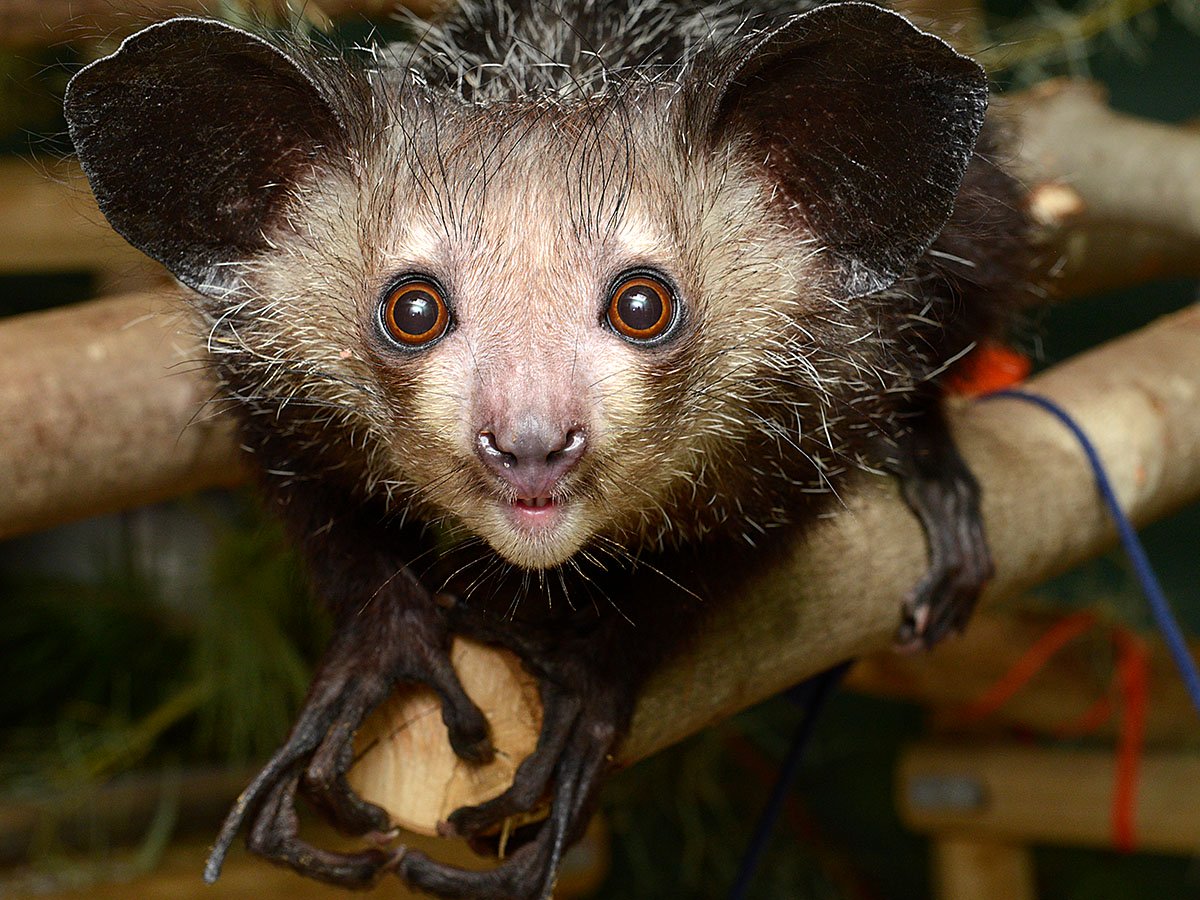
Did you know that aye-aye Ardrey is currently the oldest female lemur living at the Duke Lemur Center? At 30.5 years old, this beautiful lady shares an enclosure with geriatric dad Poe and bush baby Flame Thorn at the front of our nocturnal building. If you've visited on a tour and caught a glimpse of an aye-aye, it was more likely Poe than Ardrey, as this shy girl spends most of her time in the private half of her living space and only occasionally peeks her head in through the shift door. Ardrey is great at building nests and at participating in positive reinforcement training with her keepers... AND she's super cute! 😍
📸: David Haring ... See MoreSee Less
9 CommentsComment on Facebook
Happy #NationalVetTechWeek to our incredible veterinary technicians, Chrissy and Cat! 💙
We are so thankful to have two passionate, dedicated vet techs on our full-time staff. This is an appreciation post for Cat and Chrissy, who are integral in making sure all of our residents are happy and healthy at all stages of life, and for all of the other vet techs over the past 60 years who have helped us provide the highest quality of care to our lemurs 🩺
📸: Sara Sorraia ... See MoreSee Less
5 CommentsComment on Facebook
Celebrate World Lemur Day in Madagascar with our SAVA Conservation Team! 💚
➡️ lemur.duke.edu/WLD26
In collaboration with Exploring by the Seat of Your Pants, we will be hosting THREE livestreams next week! On World Lemur Day (10/30), join our team as they attend a live community outreach event in Madagascar's SAVA region. The following day (10/31), tune in at two different times to explore Madagascar's unique forests and catch a glimpse of wild lemurs! 🌍
All livestreams are completely free to attend, and all links are available through the World Lemur Day 2026 page on our website ✨ ... See MoreSee Less
4 CommentsComment on Facebook
This year, more than 30 rice farmers doubled their harvests using improved agricultural techniques 🌾
Think about what that means. More food on the table. More income. Less vulnerability during difficult seasons. More parents able to send their children to school.
When farmers succeed, forests are preserved because families can produce more from their permaculture fields and have no need to turn to forests for new land or income.
Conservation and food security are not competing goals. They are partners.
This intervention is part of a package of training programs that was requested by the local communities surrounding the Marojejy National Park as part of their community conservation initiative, supported by the Duke Lemur Center.
Our work in regenerative agriculture is funded by General Mills and generous philanthropic gifts from our Lemur Center supporters. Will you help more farmers embrace agroecology?
🌾🌿
#agroecology #foodsecurity #Madagascar #regenerativeagriculture #farmersfeedtheworld #farmtotable #permaculture #MadagascarMonday ... See MoreSee Less
5 CommentsComment on Facebook
Handsome portraits of aye-aye Binx taken by Rhiannon, a former DLC intern and Undergraduate Fellow in Communications 🤩
Four-year-old Binx is currently the youngest of ten aye-ayes residing at the Duke Lemur Center! He shares his name with Thackery Binx, the boy-turned-black cat from "Hocus Pocus." Like most aye-ayes, Binx lives alone in his "bachelor pad" and sleeps in a carefully crafted nest made of fleece and browse 😴
➡️ lemur.duke.edu/onsite-tours-ww
You can help make snacks for aye-ayes like Binx, as well as some of our resident diurnal lemurs, in our Enrichment Wild Workshops! These hands-on programs run most Saturday and Sunday afternoons through our off-season (October to April) and are open to guests ages 10+. Tickets are available for purchase through the end of December on our website! 🎟
📸: Rhiannon Jenkins ... See MoreSee Less
5 CommentsComment on Facebook
Black and white ruffed lemurs Sputnik and Sunshine stun in the summer sun ☀️
What a gorgeous pair of siblings! While most lemur species typically birth singletons or twins, ruffed lemurs can have up to SIX infants at once! Sputnik and Sunshine are triplets, along with littermate Orbit, which are actually more common than singletons for ruffed lemur mamas. These gorgeous lemurs are the offspring of mom Halley, who is one of our most prolific ruffed lemur supermoms and boasts a total of nine offspring across four litters 😍
➡️ lemur.duke.edu/adopt
Want to learn more about this critically endangered species while contributing to their care and conservation? You can symbolically adopt Halley through our Adopt a Lemur program! Adopters get quarterly updates on the family, as well as access to adopter-exclusive materials, printable photos, and more 💙
📸: Sara Nicholson ... See MoreSee Less
3 CommentsComment on Facebook
Did you know that today is World Food Day? 🌍🌽
Conservation and food security are deeply connected.
When rural families in Madagascar have productive farms, healthy soils, and diverse crops, they are better positioned to invest in their futures and reduce their need for natural resources from nearby forests.
This year, over 3,800 farmers participated in our programs and improved rice harvests, expanded agroforestry systems, produced abundant vegetable gardens, and diversified income sources.
One farmer put it best: "I harvest enough rice and vegetables for my family for the whole year."
On World Food Day, we celebrate the farmers feeding their families while restoring their landscapes.
We are grateful to General Mills, the McQuade Foundation, and the Swiss National Science Foundation's collaborative project with the University of Zurich for supporting our work in agroecology, food security, and rural women’s development 💚
🌾🌱
#WorldFoodDay #Agroecology #FoodSecurity #Madagascar #Restoration #RegenerativeAgriculture ... See MoreSee Less
5 CommentsComment on Facebook
Did you know that today is International Day of Rural Women? 🌍
When you visit our partners in Madagascar, you'll quickly notice something: Women are leading.
They nurture tree seedlings in nurseries, cultivate gardens, and raise chickens and fish.
They lead savings groups.
They support family health.
They conduct research and sustainable development.
They hold positions of authority and strengthen local organizations.
When speaking about the outcomes of her participation in the Lemur Center’s programs, one woman recently told us: "My life has improved."
Sometimes four words tell a bigger story than any statistic ever could.
Today we celebrate the strength, leadership, and resilience of rural women throughout Madagascar.
Our projects related to rural women’s development are supported by the McQuade Foundation, General Mills, and the Swiss National Science Foundation collaborative project with the University of Zurich.
💚
#RuralWomen #WomenEmpowerment #WomenInConservation #Madagascar ... See MoreSee Less
4 CommentsComment on Facebook