The time is now
Lemurs are the most endangered mammals on Earth

about
Duke Lemur Center
Founded in 1966 on the campus of Duke University in Durham, NC, the Duke Lemur Center is a world leader in the study, care, and protection of lemurs—Earth’s most threatened group of mammals.
With more than 200 animals across 13 species, the DLC houses the world’s most diverse population of lemurs outside their native Madagascar.
Want to visit? We’d love to host you! Just note that tour reservations are required in advance.
Our Mission
To advance science, scholarship, and biological conservation through non-invasive research, community-based conservation, and public outreach and education.
Facebook Feed
Hot day? No problem! If you're a professional jokester like Pax, you can play AND lounge on your back 😝
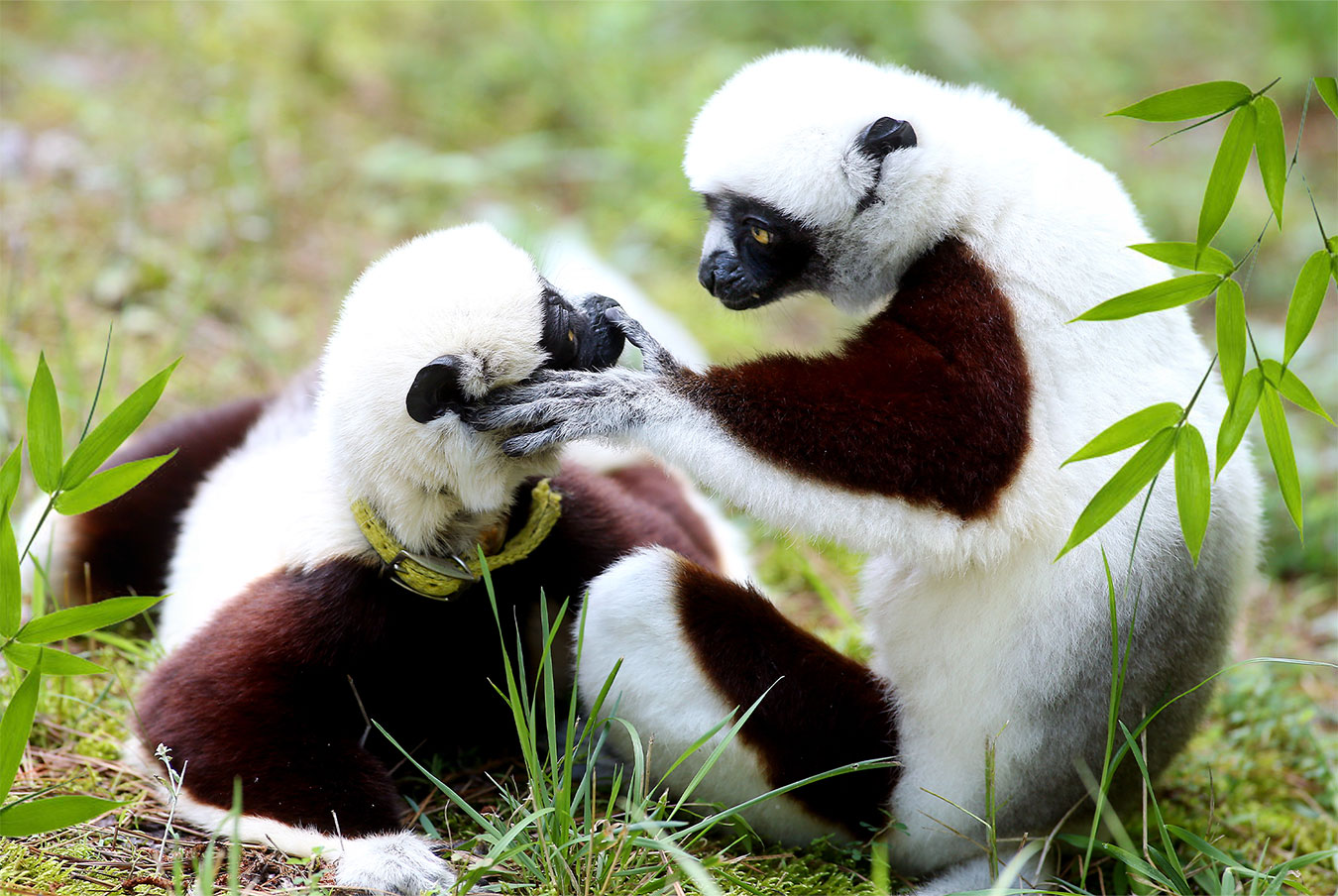
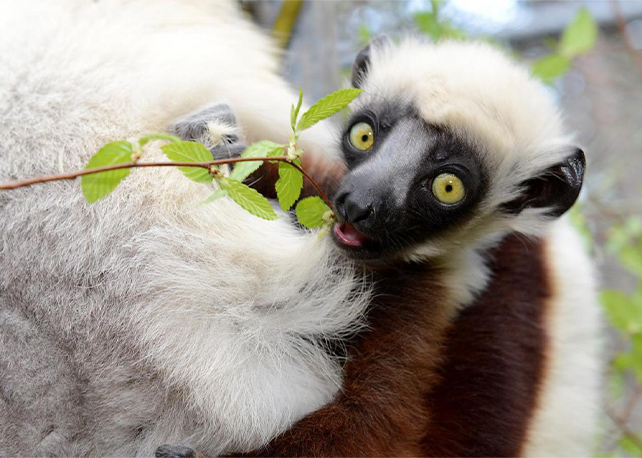
Coquerel's sifakas like Pax are native to the dry deciduous forests on Madagascar's west coasts. During the dry season, temperatures stay generally in the 70s, while the forest heats up to the 80s and 90s during the hotter wet season. You might see lemurs perform a number of behaviors to cool down on hot days, including licking their palms (saliva evaporating cools them down) and lying flat on their bellies (ground temperature is often cooler than air temperature). That doesn't stop playful young adults like Pax from goofing off—rather than hopping around in the heat, she makes play faces at her mom and dad from the comfort of a cool shelf in her family's screened-in outdoor patio 💕
On particularly hot days, our husbandry team will also provide lemurs with popsicles and/or frozen water bowls 🧊
📸: David Haring ... See MoreSee Less
1 CommentsComment on Facebook
Stay cool this summer during your visit to the Duke Lemur Center! ☀️
Here in North Carolina, temperatures are getting HOT! Most of our tours operate mostly or entirely outdoors, so here are some tips and tricks to make sure you prepare for a summer tour with the lemurs. Our team are trained to respond to any medical emergencies that may arise, but we'd rather everyone leaves their tour feeling happy and healthy! 😅
Feel free to reach out to our education team (primate@duke.edu) if you have any concerns or questions before your tour 💙 ... See MoreSee Less
1 CommentsComment on Facebook
Snapshots from the AZA Mid-Year Conference in Atlanta this past March 📸
➡️ lemur.duke.edu/dlc-at-aza
DLC Safety Coordinator and Lead Primate Technician Madison was recently asked to serve as the education subcommittee chair for the AZA Safety Committee. As part of this role, Madison was in charge of planning, organizing, and facilitating the Safety Summit, a three-day conference within the AZA Mid-Year Conference 😊
During the conference, Madison led a Job Hazard Analysis Workshop, as well as two roundtable discussions on Firearms Team Vetting and Trauma Informed Leadership. In partnership with Utah’s Hogle Zoo and the AZA Safety Escapes and Exposures subcommittee, Madison gave a 30 minute presentation on why training for large trauma events is important, how institutions across the US prepare, how to stock/maintain trauma kits, and the experiences she has that make her so passionate about the training. Madison also served as a panelist on a firearms panel, answering questions about weapons, training, and emergency response 🚑
"It was inspiring to see so many leaders in zoos and aquariums have such a passion for their employees’ and animals’ safety," says Madison. "I learned so much about very niche topics through their passion and genuine concern for making sure everyone gets to go home after their shift." 💙 ... See MoreSee Less
2 CommentsComment on Facebook
Deep within the heart of the Duke Lemur Center’s vast campus, you’ll find a small patch of land speckled with fruit trees and vegetables 🫐
➡️ lemur.duke.edu/where-hope-takes-root
This is the secret garden known as “Charlie’s Food Forest,” named after Charlie Welch, who led conservation programs for the Lemur Center for 35 years before retiring in 2024. It is a playground of pawpaws, blueberries, corn, beans and, among other circulating crops, sumac—the leafy green snack of choice for many lemurs 🌿
Every week Welch, Lemur Center staff, and a dozen or so volunteers spread out among the planted beds to harvest organic goodies to supplement the diets of the center’s more than 200 resident primates 🫘
“There are really beautiful things that come out of it,” says Sheri Taylor, a Lemur Center staff specialist and horticulturalist, who leads the volunteers into the food forest each week. “We are out here sweating in 100-degree weather, in almost freezing temperatures. But we start talking about our lives and find that common ground with people who we otherwise wouldn’t necessarily have met. I leave feeling like, ‘OK, I’m ready. I’m energized.’” 🤗
Read more on our website at lemur.duke.edu/where-hope-takes-root ✨ ... See MoreSee Less
9 CommentsComment on Facebook
"Pose for the camera!" vs "Now let's take a silly one!" 📸
Can you believe that Coquerel's sifaka Arcadius is turning two in just a few months? This playful young adult free-ranges in the forest with mom Gisela, big brother Silas, and baby sister Pomona. While Silas helps mom keep a close eye on the five-month-old infant, Arcadius is far more focused on entertaining himself, leaping energetically from tree to tree and dangling upside down while nibbling on fresh leaves. In the second photo, Arcadius demonstrates a sifaka "play face," an invitation for his siblings (or mom!) to initiate play wrestling or chasing 😆
➡️ lemur.duke.edu/adopt
Want to keep up with Arcadius and his family? You can symbolically adopt mom Gisela through our Adopt a Lemur program! Adopters get quarterly updates on the family, as well as access to adopter-exclusive materials, printable photos, and more! All purchases contribute to the care and conservation of lemurs, so it makes the perfect gift to yourself or a loved one 💙
📸: David Haring ... See MoreSee Less
6 CommentsComment on Facebook
Some beautiful photos of the honeybee queen herself, Melissa 🐝
Now that Liesl's twins are four months old, they're growing into their own distinct personalities! Melissa is definitely the adventurous twin. Not only does she spend more time exploring on her own than twin brother Karl, but she also seeks out more interaction with big sister Hedwig and dad Schwepps. Melissa's current favorite activity is picking things up in her mouth and running around with them! 🥰
Lemurs are female dominant, and Liesl is a fantastic matriarch, mom, and troop leader. Little lemurs learn primarily by observing the adults in their lives, so we hope Melissa will grow up to be a strong, confident leader just like her momma 💕
📸: Sara Nicholson ... See MoreSee Less
7 CommentsComment on Facebook
This is a Karl appreciation post 🤩
Ring-tailed lemur Liesl's infants are now four months old, and the honeybee twins are starting to develop more distinct personalities as they grow up! Karl is a big momma's boy—if you see Liesl with only one infant, it's usually Karl. That doesn't stop him from playfully chasing his sister from tree to tree and exploring all of the interesting foliage in his family's forest habitat! You can tell the twins apart from one another thanks to a tail shave, aka a small shaved section of fur on Karl's tail (visible in the second photo), which is just as harmless as a haircut and allows our staff to quickly distinguish him from twin sister Melissa 💖
You'll also notice that momma Liesl is now wearing a collar! This is a radio tracking collar that allows our staff to locate her and her troop in their 16-acre forest enclosure. New moms don't wear collars to prevent tiny hands and heads from getting stuck, but the twins are too big for that to be an issue now 🐝🐝
📸: Sara Nicholson ... See MoreSee Less
4 CommentsComment on Facebook
To celebrate the end of #PrideMonth, our team prepared some colorful snacks for the lemurs! 🌈
The Duke Lemur Center is proud to celebrate love, compassion, and empathy throughout the year, and we want to show our support this Pride Month for our LGBTQ+ friends, family, staff, volunteers, guests, and lemur lovers around the world. Y'all means all! ❤️🧡💛💚💙💜 ... See MoreSee Less
12 CommentsComment on Facebook
We’re so excited to announce our SECOND critically endangered blue-eyed black lemur infant of the year, born to first-time parents Malala and Brady... Meet Lanitra! 🤩
➡️ lemur.duke.edu/lanitra
Not only does Lanitra look like a twin of mom Malala, but the two share a birthday: April 1st! When choosing a name for Malala and Brady’s daughter, Keeper Megan (the family's primary caretaker) wanted to honor another exciting event that happened on April 1, 2026—the launch of NASA’s Artemis II mission. Lanitra (“lah-NEE-trah”) is the Malagasy word for sky, which also suits the infant’s sky-blue eyes 💙
Blue-eyed black lemurs are among the most endangered primate species in the world, with possibly fewer than 1,000 individuals remaining in the wild, so maintaining a genetically diverse population of these lemurs in human care is a crucial safety net. Last year, DLC resident Mitsiky was the only blue-eyed black lemur infant in human care, in any facility around the world. This year, having not one but two infants of this critically endangered species born in our care is an important step in preventing these incredible animals from going extinct 🌍
We don't have any photos of Lanitra with dad Brady yet, as Malala has been very protective of her infant and Brady has respectfully kept his distance. We can't wait to see the whole family interact more as Lanitra grows more independent and curious about the world around her! 😍
📸: Megan Chapman, Sarah M., Britt Keith ... See MoreSee Less
34 CommentsComment on Facebook
Visit the DLC Museum of Natural History tomorrow for our FREE monthly open house! 🤩
We're getting ready to go to the field to search for fossils! We will be looking for primate fossils in the Wyoming badlands 💀
Find out:
🔧What tools we bring to search for lemur fossils
🗺️How we know where to look for fossils
⛏️What happens when we find one
Then, come back for our July 25th Open House and see what we found! We will be unwrapping fossils fresh from the field 🦴 ... See MoreSee Less
2 CommentsComment on Facebook